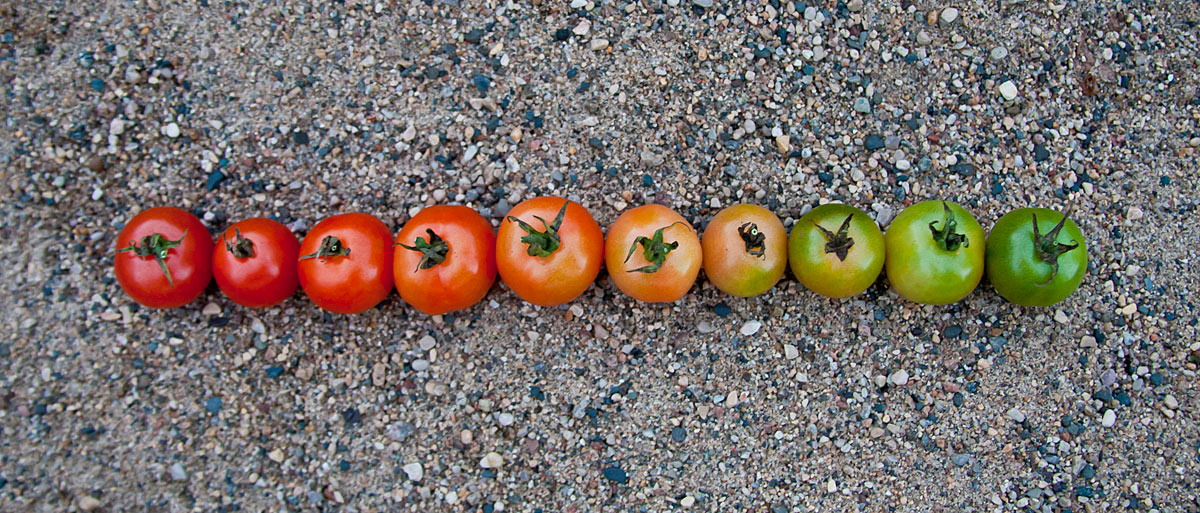
A 10-Step Hue Scale in Ripening Tomatoes
What did I say in my last post about my background in color theory showing? Here's a pic I just made in my son's sandbox:
Click the image to enlarge.
What did I say in my last post about my background in color theory showing? Here's a pic I just made in my son's sandbox:
My background teaching color theory has been showing lately. I've been becoming more and more intrigued with things like this: a "Cyanometer" from over 225 years ago.

The simple device was invented in 1789 by Swiss physicist Horace-Bénédict de Saussure and German naturalist Alexander von Humboldt who used the circular array of 53 shaded sections in experiments above the skies over Geneva, Chamonix and Mont Blanc. The Cyanometer helped lead to a successful conclusion that the blueness of the sky is a measure of transparency caused by the amount of water vapor in the atmosphere. You can learn more at the Royal Society of Chemistry.
First, the former head of the Printmaking Department at the College of Visual Arts (and my old academic advisor from YEARS ago) Maria Santiago posted this on Facebook about the Photo Biennial at Concordia:


I recently had some news shared on Inside Hamline, which is a listing of Hamline University's campus announcements, events, and student and faculty accomplishments.


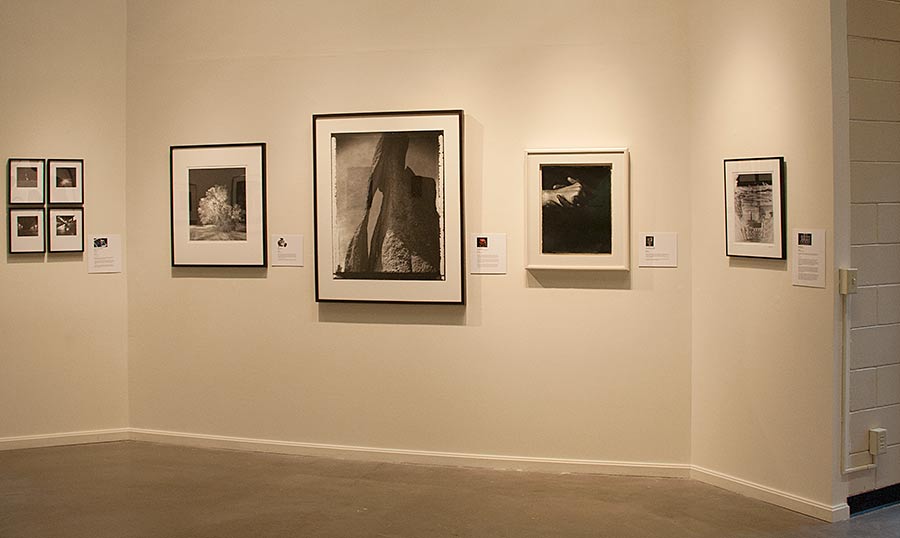
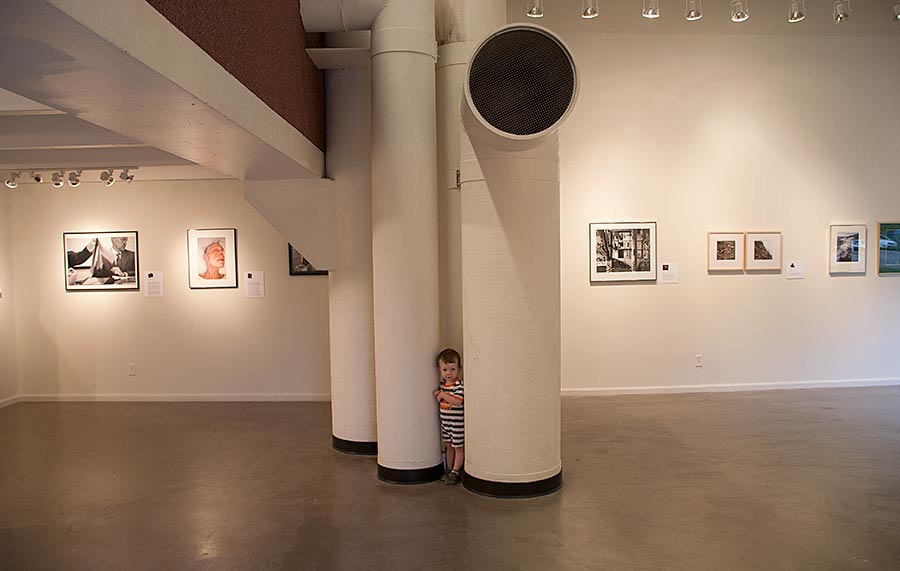
The Photography Biennial at Concordia University is about to come down. Here are some photographs of the exhibition in case you won't be able to see it:
[click on any image to enlarge]








I posted this last week on Instagram:

My 2-year-old and I recently made the trip down to Red Wing to pick up my 5 pieces that were hanging in an exhibition since June. They made the trip back to my studio just fine:

Here's an interesting idea: a German designer named Philipp Schmitt created a camera that will NOT let you take a photo if too many photos have already been taken in that location. It's called the "Camera Restricta."

The concept relies on GPS technology and geotagging: the camera body, which is 3D-printed, houses a bundle of electronics and a smartphone; the phone determines a user’s location and runs an application that scans the photo-sharing communities Flickr and Panoramio for existing pictures taken and tagged at sites within a 115-foot radius of the device. If that number is 35 or less, the camera’s screen, which displays the number of photos the application has tracked as well as one’s GPS coordinates, will read YES — and photographers may snap away. But if that number is over 35, a large, red X and an error message will appear, the shutter button will retract, and users will likely be frustrated.


 Posts
All Comments
Posts
All Comments
Posts
All Comments
Posts
All Comments

© Blogger template 'Minimalist F' by Ourblogtemplates.com 2008
Back to TOP

